From Carob Seeds to Karats: The Ancient Tree That Standardized Gold and Gems
How a small Mediterranean seed became connected to the way we still measure gemstones and gold.
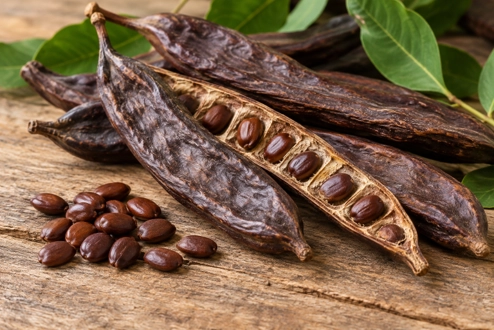
A couple of years back I was on a tour in Turkey and our guide stopped at a particular tree to show us the small seeds it produced. She explained that the seeds were known for being similar in size and weight and had been used in ancient times to weigh precious stones and metals. I had never heard of that, and it caught my interest.
I had no idea at the time, but years later I would build a website around the value of precious metals. The tree was the carob tree, and the story stuck with me. Those little seeds are connected to words we still use every day in the gold and jewelry world: carat and karat.
A Simple Solution to a Difficult Problem
Gold, pearls and gemstones are small and valuable. They need to be weighed accurately. In ancient times, a time when standards were less common, what was the solution? Today we have electronic scales, calibration weights, and agreed-upon units of measure.
In ancient times, they had rudimentary balance scales. And for standard weights, they had carob seeds.
Carob seeds weigh roughly 0.2 grams each, and this unit has become the weight of the modern metric carat.
For a long time, the story was that carob seeds were naturally so uniform that they made almost perfect little weights. The real story is a little more complicated.
Are Carob Seeds Really That Uniform?
The seeds are close but not perfect. A 2006 study found that individual carob seeds can vary in weight by about 23%, which is not unusual for a plant seed. Researchers believe people were able to identify fairly minor size differences between seeds and created consistency through visual inspection.
The seeds did not have to be identical, just close enough. By selecting seeds of similar size, they created a practical set of small reference weights. A simple solution using something that was readily available.
How a Seed Became a Carat
The word itself traveled along with the trade. The Greek word keration referred to the carob and meant "little horn," a description of the pod’s curved shape. The word moved through Mediterranean and Middle Eastern trade languages, including the Arabic qirat and Italian carato, before eventually becoming carat in English.
Today, carat and karat mean two different things in American usage. A carat is a unit of weight used for gemstones. A karat tells us the purity of gold.
Why Gold Is Measured in 24 Karats
The 24-karat system is tied to the Roman monetary system under Emperor Constantine. The gold solidus was struck at 72 coins to the Roman pound. Each coin was therefore equal to 24 smaller weight units known as siliquae, or carats. Over time, that 24-part relationship became associated with describing the purity of gold.
That is the system we still use today:
- 24K gold = 24/24 parts gold — conventionally treated as pure gold
- 18K gold = 18/24 parts gold — 75% gold
- 14K gold = 14/24 parts gold — about 58.3% gold
From Carob Seed to Metric Carat
There was still a problem. A natural seed is not a precision instrument. Different places could use slightly different standards, and a carat did not always represent exactly the same weight.
International trade eventually needed a fixed standard. In 1907, the metric carat was standardized at exactly 200 milligrams, or 0.2 grams, similar to the seed but now locked in.
The seeds are no longer needed as a measurement, but their legacy lives on.
The Problem Hasn't Really Changed
This is the part of the story I find most interesting. For all of the changes in technology, the basic problem is still the same: How much precious material do I have, and what is it worth?
An ancient merchant might have answered the first part with a balance scale and a set of tiny reference weights. Today we can measure an item in grams, identify its gold purity, use a current spot price and calculate its melt value in seconds. The tools are more sophisticated, the need is the same.
I created the PreciousCalc Gold Calculator to help with part of this equation. I recognized there was an asymmetry in information when people sell their gold. I’ve experienced this firsthand. I felt there should be a simple calculator that demystifies the exchange and puts power back into the hands of the seller. Enter the weight and karat and the calculator will estimate the item's pure gold content and melt value. Because no one should be offered $50 for a $50 pure gold coin.
I certainly wasn't thinking about any of that when a tour guide in Turkey showed me a handful of little brown seeds. I just thought the story was interesting. Years later, it seems like a fitting story to tell here.
I hope you found this interesting and I hope the website is helpful.
References
- Turnbull et al., “Seed size variability: from carob to carats,” Biology Letters (2006)
- BIPM — Proceedings of the 4th General Conference on Weights and Measures (1907)
This article is provided for informational and educational purposes only and does not constitute financial, investment, appraisal, or other professional advice.