Metals 101: The Everyday Guide to Precious and Industrial Metals
Metals are everywhere, and they’re easy to overlook and take for granted. They are in our jewelry, homes, cars, phones, appliances, power grids, and financial markets. Yet unless you buy, sell, collect, or work with them, you may rarely think about what they are worth or why their prices change.
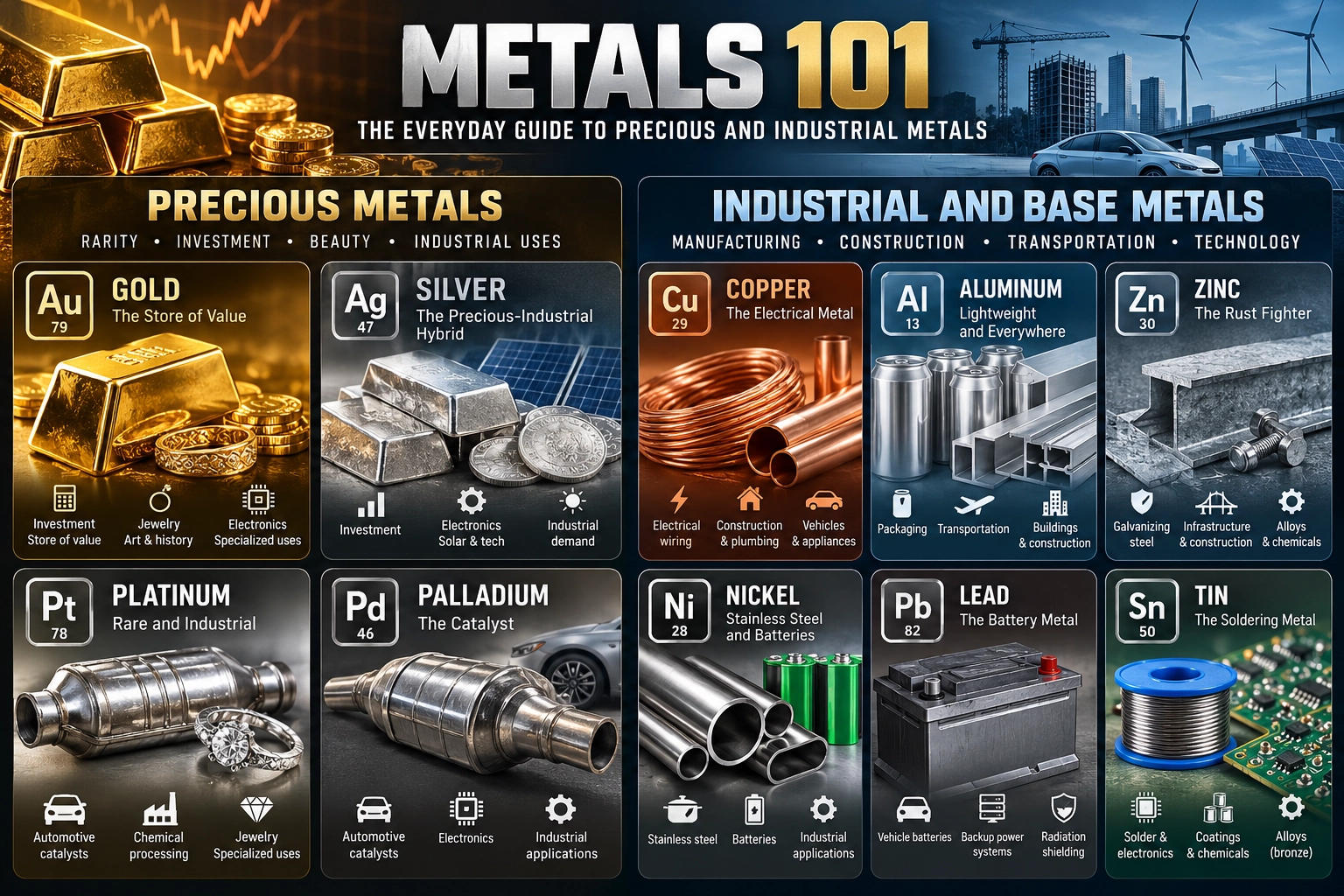
For our purposes, the metals covered here fall into two broad groups: precious metals, valued for a combination of rarity, investment demand, beauty, and industrial uses; and industrial or base metals, used extensively in manufacturing, construction, transportation, infrastructure, and technology. There is some overlap but let’s break it down.
Precious Metals
1. Gold (Au) — More Than a Precious Metal
Gold occupies a unique place in human civilization. For thousands of years it has been used as money, a store of wealth, a display of status and power, jewelry, religious objects, art, and decoration.
Gold is rare, does not rust or tarnish, and is extraordinarily malleable. It can be hammered into extremely thin sheets or drawn into fine wires. Those properties have carried gold from ancient ornamentation into modern electronics.
Today gold appears in jewelry, coins, bullion, investment products, central-bank reserves, electronics, semiconductors, communications equipment, and aerospace applications. Gold has even been sent to the Moon on NASA's Apollo missions.
Its price can be influenced by interest rates, currencies, inflation expectations, geopolitical uncertainty, investment flows, central-bank activity, jewelry demand, mine production, and recycling.
2. Silver (Ag) — The Precious-Industrial Hybrid
Silver is both a precious metal and an important industrial material. It has a long history as money, jewelry, tableware, and a store of value, while its exceptional electrical and thermal conductivity make it useful in modern technology.
Silver is used in electronics, electrical systems, solar energy, vehicles, and many other industrial applications. Its price therefore reflects forces from both the investment world and the industrial economy.
3. Platinum (Pt) — Rare and Industrial
Platinum is one of the platinum-group metals. It is rare, durable, corrosion-resistant, and highly useful as a catalyst.
Its uses include jewelry, catalytic converters, chemical and petroleum processing, medical applications, and other specialized industrial processes.
4. Palladium (Pd) — The Catalyst
Palladium is another platinum-group metal with important catalytic properties. Automotive catalytic converters have been a major source of demand, and palladium is also used in electronics and chemical applications.
Because mine production is concentrated in a relatively small number of countries, changes in supply can have an important effect on its market.
Industrial and Base Metals
5. Copper (Cu) — The Electrical Metal
Copper is one of the most important industrial metals. Its high electrical conductivity, ductility, and corrosion resistance make it essential for electrical wiring, plumbing, electronics, motors, power systems, construction, and transportation.
Because copper is used across so many parts of the economy, market observers sometimes call it “Doctor Copper,” suggesting that its price can provide clues about industrial and economic activity. It is an interesting indicator, not a crystal ball.
6. Aluminum (Al) — Lightweight and Everywhere
Once considered rare, aluminum is an abundant, lightweight, corrosion-resistant and highly recyclable industrial metal.
It is used extensively in transportation, packaging, construction, electrical applications, machinery, and consumer products. Its low weight makes it particularly valuable where reducing mass matters.
7. Zinc (Zn) — The Rust Fighter
Zinc's most important role is protecting steel from corrosion through galvanizing. That connects zinc demand closely with construction, infrastructure, transportation, and manufacturing.
Zinc is also used in brass and other alloys, batteries, and chemical applications.
8. Nickel (Ni) — Stainless Steel and Batteries
Nickel is valued for the strength, corrosion resistance, and heat resistance it can add to alloys. Stainless steel is its largest use; the U.S. Geological Survey has estimated that roughly 65% of nickel consumed in the Western world goes into austenitic stainless steel.
Nickel is also important in batteries, specialty alloys, plating, and other industrial applications.
9. Lead (Pb) — The Battery Metal
Lead is dense, soft, and highly recyclable. Its dominant modern use is in lead-acid batteries for vehicles, backup power, industrial systems, and energy storage.
Its density also makes it useful for radiation shielding and other specialized applications.
10. Tin (Sn) — The Soldering Metal
Tin is a soft, corrosion-resistant metal best known today for its role in solder, particularly in electronics and electrical connections.
It is also used in coatings, chemicals, and alloys. Mixed with copper, tin forms bronze—one of the most historically important metal alloys.
Putting It All Together
These metals may share a commodity price chart, but they do not share the same story.
Gold can move because investors are seeking a store of value. Silver can respond to both investment demand and solar manufacturing. Platinum and palladium are heavily influenced by industrial and automotive uses. Copper responds to activity across construction, electrical infrastructure, manufacturing, and transportation. Aluminum, zinc, nickel, lead, and tin each connect to different parts of the industrial economy.
Metal prices tell only part of the story. Understanding what the metals are used for, who needs them, where they come from, and what can change their supply or demand gives the prices context.