Why Would Anyone Buy Gold?
Individuals, institutions, and central banks around the world continue to own and buy gold. Why?
A Store of Value with a Very Long History
Gold has been valued across civilizations for thousands of years, serving as physical currency, jewelry, a display of wealth and power, and a way of transferring wealth from one generation to another. As currency, gold filled this role centuries before modern paper money existed. Gold remained formally connected to many currencies well into the modern era.
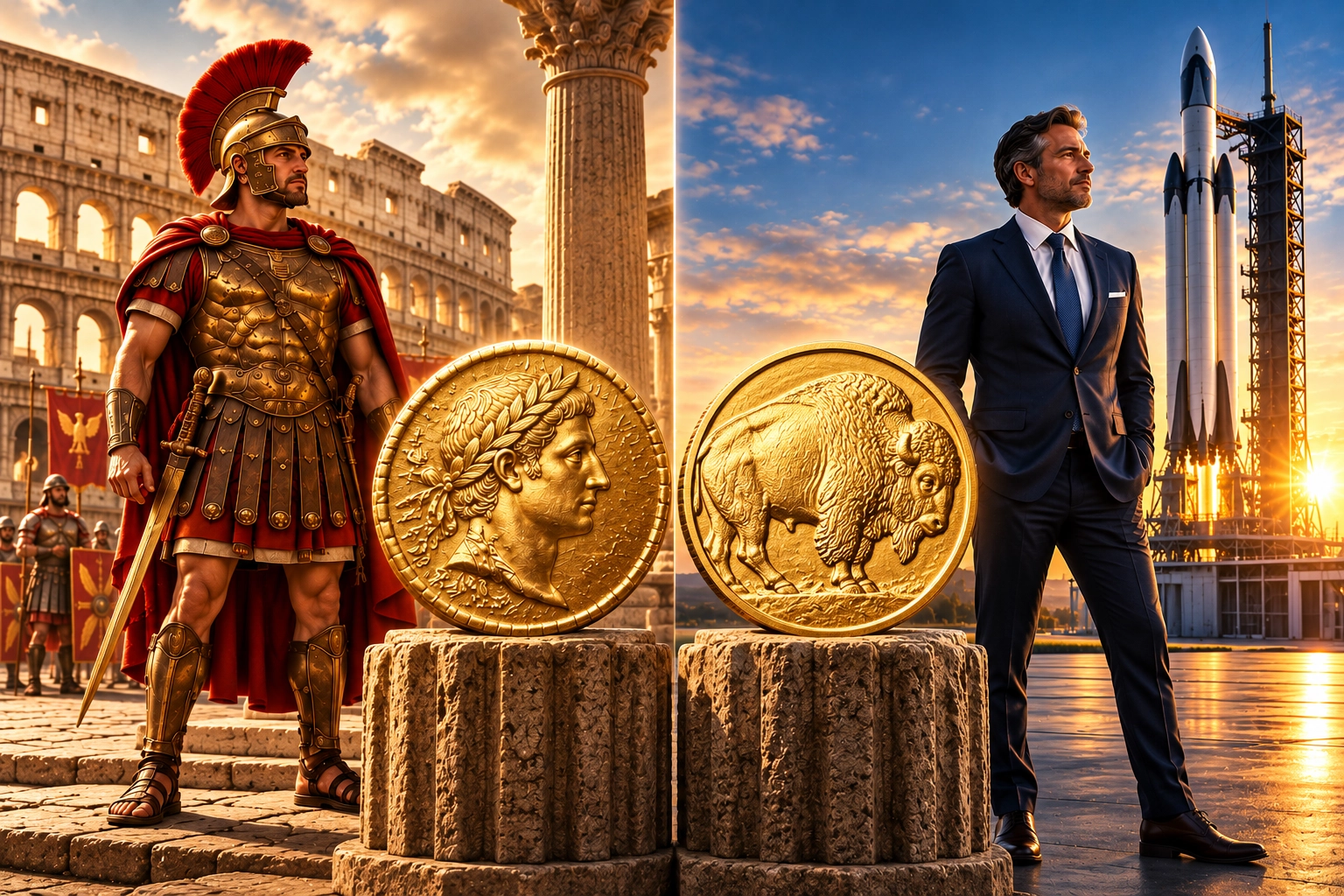
As the story goes, in ancient Rome an ounce of gold could buy a Roman soldier a well-made toga, belt, and sandals. For the price of an ounce of gold, the soldier could be well appointed. Today, that same ounce of gold can buy a high-quality man's suit, belt, and shoes.
But is this illustrative story about gold’s timeless buying power true?
As a precise historical price comparison, it is difficult to verify. Ancient Roman prices varied enormously by period, location, quality, and economic conditions. Modern research that discusses the comparison generally treats the toga story as an illustration rather than a documented price series.
But the idea behind the story isn't entirely folklore. Research by the American Numismatic Society comparing Roman incomes and basic goods with modern equivalents concluded that gold's purchasing power against basic goods has remained surprisingly stable over very long periods, even as standards of living and productivity changed dramatically.
Whether or not the traditional comparison is literally accurate, it illustrates gold's unusual ability to retain meaningful purchasing power over very long periods of time.
Physical Gold Is Not Someone Else's Promise
A bond depends on an issuer making its payments. A stock represents ownership in a business whose future value depends on that business. Money deposited at a bank represents a financial claim within the banking system.
Unlike these, physical gold carries no counterparty risk. The gold itself is the asset. It does not require a company to remain profitable or a borrower to repay a debt. This makes it particularly attractive during periods of financial or geopolitical uncertainty.
It is important, however, to distinguish physical gold from financial products tied to gold. ETFs, futures, accounts, and other products may provide exposure to gold prices, but their structures introduce intermediaries that a gold coin or bar held directly does not.
Diversification from Stocks and Bonds
Gold is also purchased for diversification. Its price responds to a different combination of forces than stocks, bonds, or real estate. Interest rates, currencies, inflation expectations, investment demand, geopolitical events, central-bank activity, mine production, and jewelry demand can all influence gold.
Gold’s relationship with other asset classes changes over time and under different economic conditions. Recent IMF analysis, for example, emphasizes that gold's hedging and diversification behavior depends considerably on the type of economic shock taking place.
Recognized Around the World
Gold isn't dependent on one company, one industry, or one country's monetary system.
It is bought, sold, and valued around the world. That international recognition gives gold a characteristic few physical assets possess: a relatively small quantity can represent substantial value and can be recognized in markets across national borders.
That does not guarantee that someone can sell gold instantly at a particular quoted price. Dealer spreads, form, purity, location, and transaction costs still matter.
But the underlying metal has a large global market and nearly universal acceptability. Central banks around the world hold gold alongside currencies, government securities, and other reserve assets.
So Why Would Anyone Buy Gold?
For some people, the answer is diversification. For others, it is the desire to own an asset outside the traditional financial system. Some value its portability and global recognition. Others view it primarily as a long-term store of value. And some simply appreciate owning something tangible that human beings have valued for thousands of years.
There are many reasons to own gold—which may help explain why people have desired to own it for thousands of years and continue to do so now.