How Can I Tell If My Gold Is Real?
Simple, non-destructive ways to gather clues about your jewelry before you sell.
Finding out whether you have real gold can be surprisingly tricky. It's a challenge merchants, jewelers, governments, and even kings have faced for thousands of years.
So don't be discouraged if your jewelry is withholding secrets.
Maybe you have an old ring tucked away in a jewelry box, a broken necklace, a single earring, or something you inherited years ago. It looks like gold—but is it? And if it is gold, how pure is it?
Fortunately, there are several things you can check before taking your gold to a jeweler or buyer. No simple home test is perfect by itself, but each can give you another piece of information about what you may have.
Why Find Out Before You Sell?
You might reasonably ask: Why do I need to know? Won't the gold buyer test it anyway?
Yes. A jeweler or gold buyer will evaluate the item themselves before making an offer.
But the point of PreciousCalc.com is to help you be better prepared before you're standing in front of a potential buyer.
If you have a reasonable idea of what you own, how much it weighs, and what its gold content might be, you're in a much better position to understand how its value is being determined and evaluate an offer.
That doesn't eliminate the importance of dealing with a reputable buyer. In fact, the less certain you are about what you have, the more important it becomes to work with someone you trust.
1. A Warning Before You Test Anything: Don't Damage Something Valuable
Some gold-testing methods can damage an item.
A scratch test, filing an inconspicuous area, applying acid directly to an item, or otherwise exposing the underlying metal may seem insignificant if you're dealing with ordinary scrap gold. But not every gold item should be treated as scrap.
An antique or vintage piece may have value well beyond the gold it contains. The same could be true of designer jewelry, a collectible coin, a historically significant object, or an unusual artifact.
A 1920s Tiffany piece, for example, should not be treated the same way as a broken piece of ordinary gold chain. And if you happen to have a piece of 17th-century sunken treasure, its melt value may be the least interesting thing about it.
This is particularly important when you don't know exactly what you have.
Search online and you'll find home gold tests involving ceramic tiles, acid, scratching, filing, vinegar, water, and other methods. Some are based on legitimate physical or chemical properties of gold. That doesn't mean they're appropriate for every item—or that they will give you a reliable answer.
Even density testing, which is based on real science, can become complicated with jewelry. A solid, simple piece is one thing. A hollow piece, gemstone setting, soldered item, or piece containing multiple metals is another.
Traditional acid or touchstone testing can also provide useful information in experienced hands. In a touchstone test, metal from the item is rubbed onto a testing stone and evaluated using acids and reference samples to estimate purity.
But this involves technique, chemicals, interpretation, and potentially altering or marking the item.
Before performing any test that could scratch, mark, chemically alter, or otherwise damage an item, consider whether the item itself could be worth more than the metal from which it was made.
When in doubt, don't damage it to find out what it is.
Start with what you can learn without altering it.
2. Start With the Markings
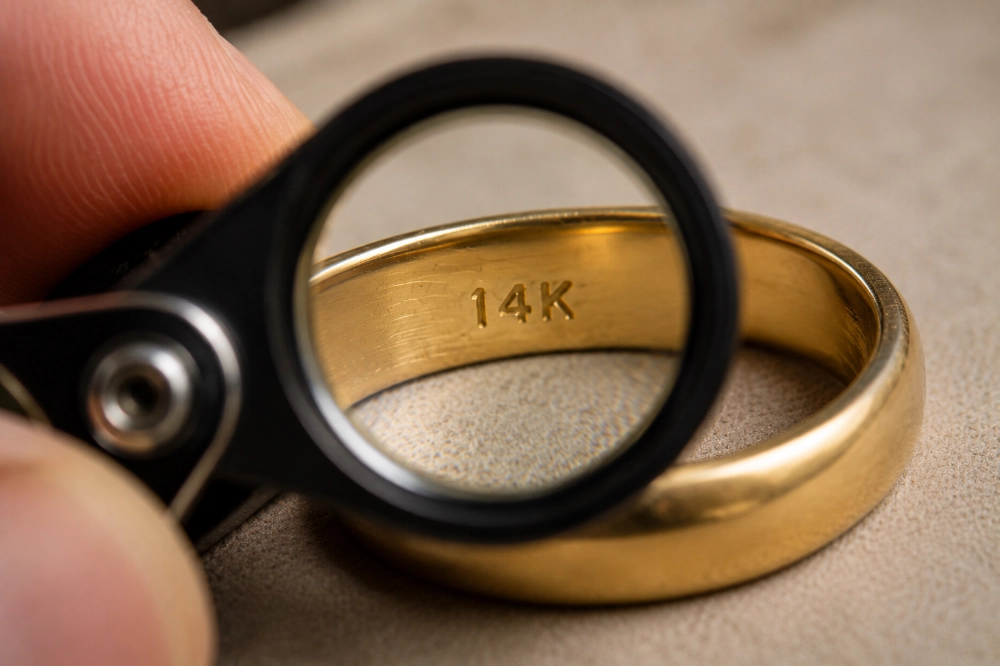
Look closely at the item for a stamp or hallmark.
On rings, check the inside of the band. On necklaces and bracelets, look around the clasp. Earrings may be marked on the post, back, or another inconspicuous area.
The marks can be extremely small, so a magnifying glass, jeweler's loupe, or the zoom function on your phone may help.
Common Gold Purity Markings
| Gold Purity | Markings You May See | Approx. Gold Content |
|---|---|---|
| 24K | 24K or sometimes 999 | 99.9%+ |
| 22K | 22K or sometimes 916 / 917 | 91.6–91.7% |
| 18K | 18K or sometimes 750 | 75.0% |
| 14K | 14K or sometimes 585 / 583 | 58.3–58.5% |
| 10K | 10K or sometimes 417 | 41.7% |
| 9K | 9K or sometimes 375 | 37.5% |
You may see gold purity expressed in karats, such as 14K, or as a three-digit fineness number, such as 585. Both are telling you approximately how much pure gold the item contains.
A 14K or 585 piece, for example, is about 58.5% gold. The remaining 41.5% is other metal, not gold, so it isn't included when calculating the item's gold melt value. In other words, if you have 10 grams of 14K gold jewelry, you don't have 10 grams of pure gold—you have approximately 5.85 grams of gold.
Gold markings vary around the world and have also changed over time, so this isn't a complete list of every mark you might encounter. Some countries use formal hallmarking systems that include additional symbols identifying who submitted or made the item and where it was tested.
A mark is evidence. It isn't proof. Marks can be incorrect, altered, or counterfeit.
3. Look for Marks That Mean Something Different
Finding the word "gold" or a karat number doesn't always mean the entire item is made from that gold alloy.
Watch for markings and descriptions such as:
- GF — Gold Filled
- RGP — Rolled Gold Plate
- Gold Overlay
- Gold Plated
- Gold Electroplate
- Vermeil — typically gold plated over sterling silver
These products can contain genuine gold. The important difference is that the gold may exist primarily as a layer over another metal rather than throughout the item.
That can make a tremendous difference when you're trying to estimate melt value.
4. Look Closely for Wear and Discoloration
Sometimes the item itself provides another clue.
Look particularly at places that receive wear: the edges of a pendant, the inside of a ring, clasps, links, and areas where pieces rub against one another.
If the gold-colored surface has worn away and you can see a distinctly different-colored metal underneath, the item may be plated.
Again, this isn't definitive proof. Genuine gold jewelry is commonly alloyed with other metals, and jewelry construction can be complicated.
But visible wear is another useful piece of evidence—and examining it doesn't require damaging the item.
5. Try a Magnet
Gold itself is not magnetic.
That makes a reasonably strong magnet useful as a quick, non-destructive screening test.
If the main body of an item is strongly attracted to the magnet, that's a warning sign that it may contain a substantial amount of another metal.
But there's an important catch:
Passing the magnet test does not prove that something is gold.
Many metals aren't strongly magnetic. And some genuine jewelry contains small springs, pins, clasps, or other components made from different metals.
Think of the magnet test as a way of finding a reason to be suspicious—not as a certificate of authenticity.
6. Other Tests & Professional Opinions
If you've learned everything you can from non-destructive inspection but still aren't sure what you have, it may be time for a professional opinion.
Depending on the item and the equipment available, a jeweler, appraiser, refiner, or gold buyer may use:
- visual inspection,
- touchstone and acid testing,
- electronic testing,
- X-ray fluorescence (XRF), or
- a combination of methods.
Even sophisticated testing methods have limitations, particularly with plated or unusually constructed pieces. Experience still matters.
If you believe an item could be antique, collectible, historically significant, or from a notable maker, consider whether a qualified appraiser or specialist may be more appropriate than someone whose primary business is buying gold for its metal value.
Knowing more about your gold helps you become an informed seller. It doesn't eliminate the need for a reputable buyer.
If you're uncertain about the purity, construction, weight, or value of an item, dealing with someone trustworthy becomes even more important.
So, Is It Real Gold?
You don't need to become an expert.
Start by gathering information.
Protect the item. Check the markings. Look for signs of plating. Examine the wear. Try a magnet. And, when the value or identity of the item remains uncertain, get an appropriate professional opinion.
You may discover that your piece is karat gold, gold filled, gold plated—or not gold at all.
But once you have a reasonable idea of what you own, the next question becomes much easier to answer: What is the gold actually worth?
For that, you need three key pieces of information:
Those are the basic ingredients used to calculate the melt value of gold.
Once you know the weight and have a reasonable estimate of the purity, use the PreciousCalc.com Gold Melt Calculator to estimate the value of the gold contained in your item before you talk to a potential buyer.
This article is provided for informational and educational purposes only and does not constitute financial, investment, appraisal, or other professional advice. Testing methods have limitations, and an item's collectible, antique, gemstone, artistic, historical, or resale value may be significantly different from its precious-metal melt value.