Will I Get Melt Value When I Sell?
In a word, probably not. But let's first understand what melt value is, and you'll see why.
1. What Is Melt Value?
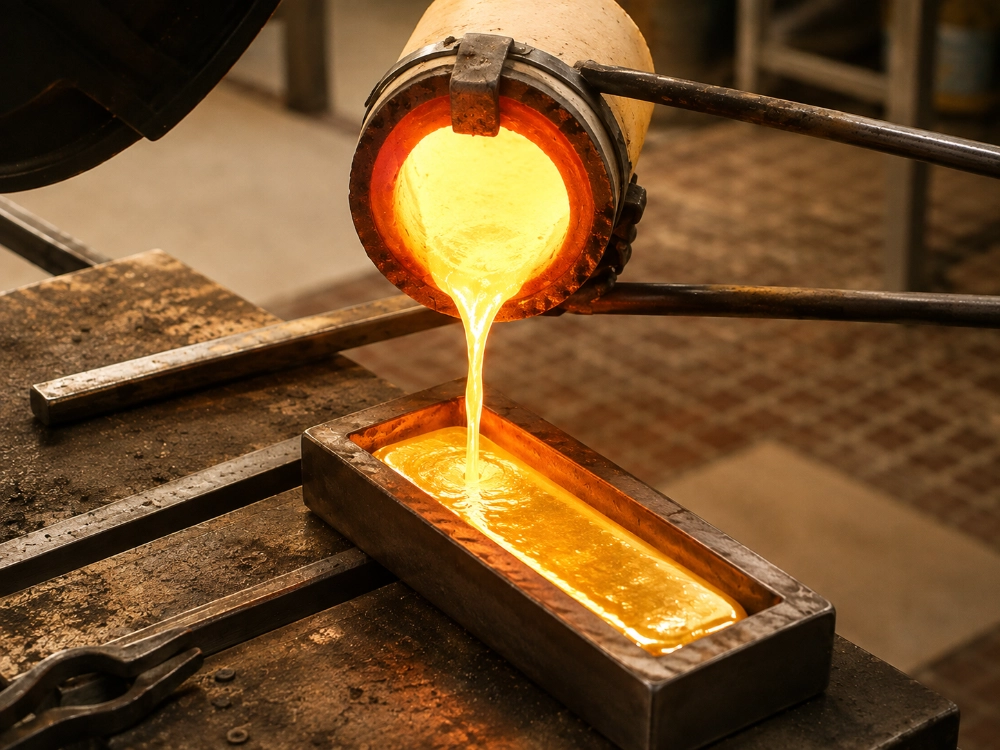
Melt value is the value of the actual gold contained in an item, based on its weight, purity, and the current price of gold.
Let's use a simple example.
Suppose you have a piece of 14K gold jewelry that weighs 10 grams. As we discussed in How Can I Tell If My Gold Is Real?, 14K gold is about 58.5% pure gold.
That means your 10-gram piece contains approximately:
The other 4.15 grams are other metals in the alloy and aren't included in the gold melt value.
So the basic idea is:
PreciousCalc.com does this calculation for you, but understanding what goes into the number will make it much easier to understand an offer.
2. What Is the Gold Spot Price?
Gold is bought and sold around the world, and its market price changes throughout the trading day.
When you hear someone refer to the spot price of gold, they're talking about the current market price of gold for spot settlement. Gold prices are commonly quoted in U.S. dollars per troy ounce.
And here's an important detail:
A troy ounce isn't the same as an everyday ounce.
One troy ounce is approximately 31.1035 grams, compared with about 28.35 grams for the ordinary ounce most Americans are familiar with.
There are also established benchmarks used by the gold market. One of the most important is the LBMA Gold Price, established twice each business day through an independently administered electronic auction in London.
You don't need to understand the workings of the international gold market to sell an old necklace. The important thing to know is that the gold price comes from a large global market. It isn't a number your local gold buyer simply decides.
3. How Does the Gold Price Become My Melt Value?
Let's return to our 10-gram piece of 14K gold.
To keep the math easy, suppose the current price of pure gold works out to exactly $100 per gram.
We already determined that our 10-gram piece of 14K jewelry contains approximately 5.85 grams of gold.
Our approximate melt value is therefore $585.
Notice that we didn't multiply all 10 grams by $100. The item weighs 10 grams, but only about 5.85 grams of it are gold.
That's what the PreciousCalc.com Gold Melt Calculator calculates for you using the current gold price.
Now we have our benchmark.
And that's where selling begins.
4. Why Won't the Buyer Just Pay Me $585?
Because the buyer isn't buying your gold as a favor.
A gold buyer is running a business.
Depending on the buyer and how the business operates, there may be costs associated with testing, handling, processing, refining, transportation, insurance, market-price changes, and ultimately reselling or refining the gold.
And, like any business, the buyer needs to make a profit.
That means the buyer generally needs some difference between the melt value of your gold and the amount paid to you.
This isn't automatically a sign that you're getting a bad deal. It's how the transaction works.
The more useful question is:
How much below melt is the offer?
5. What Percentage of Melt Am I Being Offered?
Suppose our gold has an estimated melt value of $585.
A buyer offers you $450.
Instead of looking only at the $450 offer, compare it with melt value:
The buyer is offering approximately 77% of melt value.
Now you've converted an isolated dollar amount into something you can evaluate.
Instead of asking “Is $450 a good offer?” you can ask “Is 77% of melt a good offer?”
That is a much more useful question.
And this is one of the main reasons PreciousCalc.com shows you the percentage of melt represented by an offer.
6. So, What Is a Fair Percentage of Melt?
There isn't one percentage that makes every gold offer fair or unfair.
Different buyers have different overhead, volumes, refining arrangements, risks, and profit requirements. The quantity and type of gold you're selling can also affect what a buyer is willing to pay.
But knowing your melt value gives you a reference point.
If two buyers offer different percentages of melt for the same gold at roughly the same time, that's useful information.
Don't be afraid to ask how the offer was calculated:
- What weight are you using?
- What purity did you determine?
- What gold price are you using?
- What percentage of melt are you paying?
- Are there any additional fees or deductions?
You don't have to make the conversation confrontational. You're simply trying to understand the transaction.
And whenever practical, consider getting more than one offer.
A reputable buyer should be willing to explain how the offer was determined.
7. When Is Gold Worth More Than Its Melt Value?
Sometimes melt value is the wrong way to value an item.
Suppose again that our piece contains $585 worth of gold.
If it's an ordinary broken chain with no meaningful value beyond its gold content, melt value may be a useful benchmark.
But what if it's a desirable vintage piece? What if it was made by Tiffany & Co. or another sought-after maker? What if it contains valuable gemstones? What if it's a collectible coin? What if it has historical significance?
In those cases, melting the item could destroy the very thing that makes it valuable.
A piece containing $585 worth of gold could potentially be worth considerably more as the object it already is.
Consider an extreme example: a Fabergé Imperial egg made for the Russian royal family. Some of these extraordinary pieces are highly sought after and have sold for millions of dollars—far beyond the value of the gold, gemstones, and other materials they contain. Their history, rarity, craftsmanship, and provenance can be far more valuable than the materials themselves.
Your jewelry probably isn't a lost imperial treasure—but the principle is the same. Before you value an object as gold, make sure the gold isn't the least valuable thing about it.
That's why PreciousCalc.com favors understanding what you have before treating an item as scrap.
Gold has a melt value. Objects can have other kinds of value.
Know the difference before you sell.
Know Your Number Before You Sell
So, will you get melt value when you sell your gold?
Probably not—and now you know why.
The buyer needs room to cover costs and make a profit. Your job isn't to eliminate that margin. It's to understand it.
Before you sell, try to know:
Then compare the offer with that number.
The PreciousCalc.com Gold Melt Calculator gives you that benchmark before you're standing in front of a potential buyer.
It doesn't tell you what someone must pay you.
It doesn't tell you whether you should sell.
It gives you something simpler:
A number you should know before you make the decision.
This article is provided for informational and educational purposes only and does not constitute financial, investment, appraisal, or other professional advice. Actual offers may vary based on testing results, market conditions, buyer costs and margins, and other factors. An item's collectible, antique, gemstone, artistic, historical, or resale value may be significantly different from its precious-metal melt value.