Using PreciousCalc: A Seller’s Story
What happened when I walked into a gold-buying event knowing the weight, purity and melt value of my gold before the buyer made an offer.
There is an information imbalance when most people walk into a gold-buying event.
The buyer does this for a living. The seller probably doesn’t. The buyer has a scale, knows the current price of gold, understands purity and melt value, and knows what percentage of that value he is willing to pay.
The seller may know only one thing: I have some gold. And even this could be questionable, as you’ll see from my experience.
I recently visited two traveling gold-buying events. On my first visit, I knew very little. By my second visit, I knew much more. By simply knowing the numbers, I would have been able to put nearly another $100 in my pocket. Here’s my story.
My First Visit Didn’t Go as Planned
For my first visit, I brought a small earring that I thought might be gold. I wasn’t able to read the markings with a magnifying glass.
The buyer examined it with a jeweler’s loupe. He could read markings that I couldn’t. It was sterling silver with gold plating, but unfortunately it wasn’t gold.
The earring had essentially no gold scrap value.
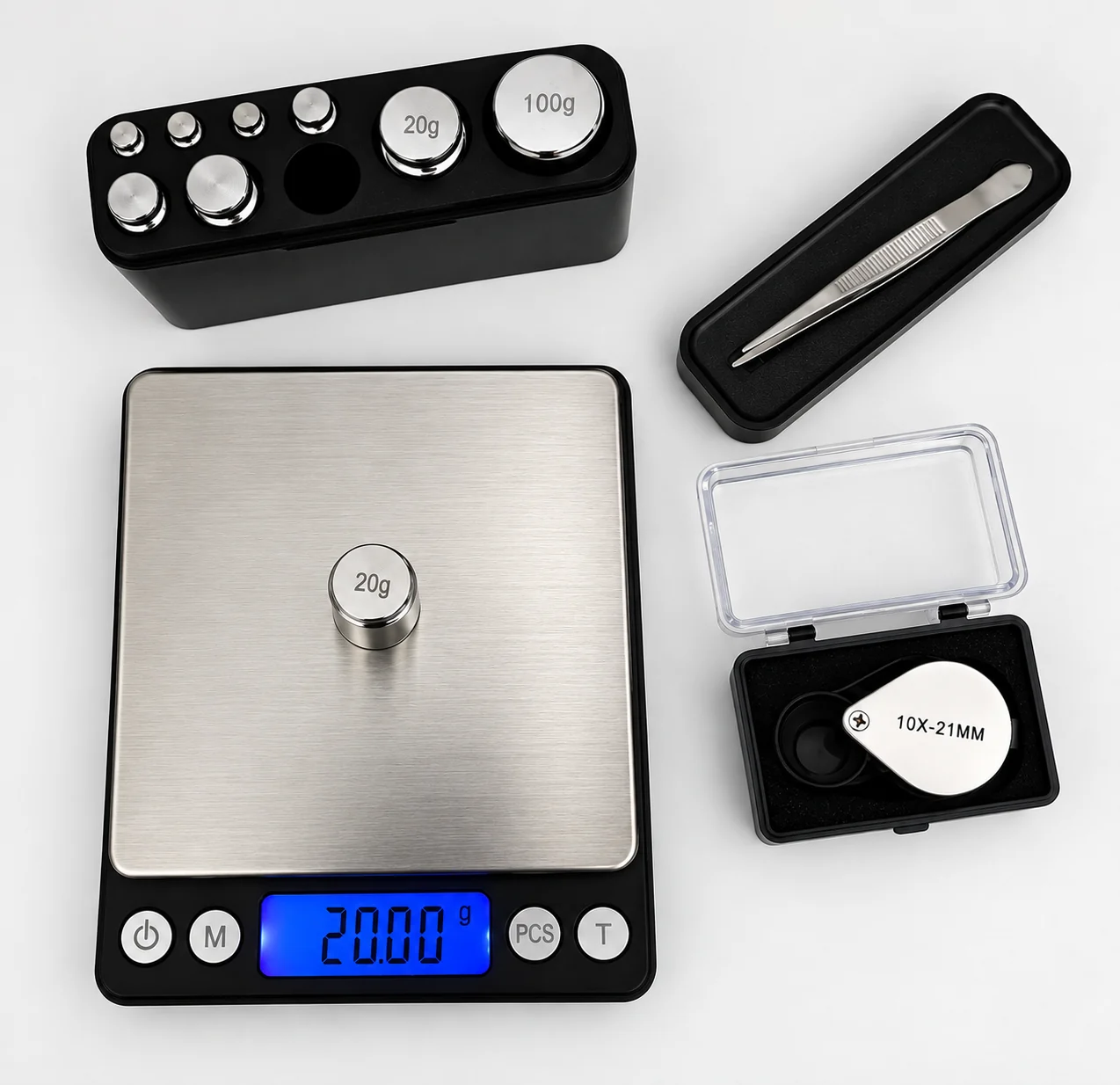
I didn’t make any money that day, but I learned something. Before trying again, I knew I needed to know more about what I was bringing through the door. I needed to even out the information imbalance. So I bought a loupe.
I also bought a digital scale, which I later returned because it wasn’t accurate. When I weighed the same object more than once on that scale, I sometimes got different results. That wasn’t good enough. I bought a better scale and a set of calibration weights.
The second scale performed much better. I checked it at 1, 5, 10, 20, 50 and 100 grams. It was accurate at the lower weights but slightly off at 50 and 100 grams, so I calibrated it.
That experience taught me another lesson. Don’t assume a scale is accurate just because it displays a number.
I Leveled Up for the Next Attempt
For my second visit, I brought two gold cufflinks that belonged to my grandfather.
I would never actually sell them because their sentimental value to me is worth far more than their gold content. I just wanted to test the process, and they were perfect for this experiment.
The cufflinks were clearly marked 14K. I used my loupe to confirm the marking, although in this case it wasn’t really necessary. Regardless, there was no doubt.
Using my calibrated scale, I weighed them at 9.17 grams.
Before leaving for the event, I entered 14K and 9.17 grams into PreciousCalc. Based on the gold spot price at the time, the estimated melt value was $752.73.
I wrote these numbers down. This time I wasn’t walking into the room wondering what I had or what it might be worth. It was game on.
He Hit Me with a Low-Ball Offer
I was the only customer at the second event when I arrived. I went right to the buyer’s table. He looked at the cufflinks and acknowledged that they were marked. He didn’t initially tell me what they weighed or walk me through his calculation.
He gave me a number.
$404.
That is an interesting number.
It isn’t $400. It’s $404. A specific number can sound like the result of a precise calculation.
But I already had my own calculation. I didn’t object, haggle, or negotiate. I just asked questions.
“What spot price are you using?”
$4,300.
“How much do they weigh?”
9.1 grams.
That was reassuring. I had measured 9.17 grams on my scale at home. His measurement was very close to mine.
Then something else happened. Without me saying another word, he increased his offer to $500 even. The offer jumped $96 from two simple questions that I already had answers to.
Using the $752.73 melt value I had calculated before the event, the initial $404 offer represented about 54% of melt value. The $500 offer represented about 66%.
Nearly a 24% jump without haggling.
To keep the interaction going just a little longer, I tried to calculate his percentage in my head, which I of course did incorrectly.
I said something along the lines of, “So you’re offering about 75% of melt?”
The buyer quickly confirmed that I was right. (I wasn’t.)
If I were to do it again, I would have PreciousCalc.com on my phone and use it while we talked. As it turned out, I only had my handwritten notes.
I declined the $500, and he responded with, “What were you looking to get?”
Suddenly I’m getting to set the price. I thanked him and left with my cufflinks.
The Information Imbalance
The buyer buys gold regularly. He has the scale. He knows the spot price. He understands how purity affects value. He knows the margin he needs and the offer he is prepared to make.
Once it became clear that I had that same information, the information imbalance had narrowed, and the dynamic changed.
Knowledge Is Power, Especially When Selling Gold
A lot of people don’t like to negotiate. The good news is that you don’t have to start by negotiating. Start by checking the numbers.
What does the item weigh? If you don’t have a jeweler’s scale, a scale that can accurately weigh in grams should be helpful. Honestly, jeweler’s scales aren’t expensive and the cost could easily be justified. The one I bought was under $30 on Amazon.
What purity is it? This is where the markings are extremely helpful. The jeweler’s loupe was also very inexpensive.
What spot price is the buyer using? The buyer’s spot price should be reasonably close to the current spot price you can find online or in PreciousCalc.com, which is retrieved automatically.
What melt value did the buyer calculate? PreciousCalc.com really shines here. If you have weight, purity, and spot price, you have everything you need to be effective.
What percentage of melt is the buyer offering? My mistake was trying to calculate it in my head. A better approach would have been to simply ask him—or enter his $500 offer into PreciousCalc and let the calculator do the math.
All of this is just information. None of it is negotiation, and it certainly isn’t haggling.
You’re simply asking verification questions, armed with answers ahead of time.
Check the Scale Too
Weight matters.
If the buyer had weighed my cufflinks at 8.5 grams when I had measured 9.17 grams at home, I would have asked another question:
“When was your scale last calibrated?”
That isn’t an accusation.
I learned from my own experience that scales can be off. That’s why I bought calibration weights and checked mine at home. I had confidence in my measurement.
If your measurement and the buyer’s measurement are materially different, find out why before going any further.
In my case, the measurements were close enough that the scale wasn’t an issue.
That gave me confidence that we were working from essentially the same weight.
My Small Investment (Would Have) Paid for Itself
The $96 came after I started asking questions. My equipment cost less than that.
Between my first and second visits, I bought a jeweler’s loupe, a better digital scale and calibration weights. Together, they cost me $55. That’s less than the $96 difference between the buyer’s first and second offers. And PreciousCalc was free.
I didn’t need to become a gold expert. I needed to know what I had, what it weighed, and approximately what its gold content was worth. That was enough to change the conversation.
What I Learned
My first trip taught me not to assume something is gold. My second taught me not to assume an offer is the best a buyer can do.
Know the purity, the weight, the current spot price, and then calculate the melt value before you go.
Ask the buyer what weight and spot price they’re using.
Ask what percentage of melt they’re paying.
If the numbers don’t agree, ask why.
And if you’re not comfortable with the offer, you can always leave and compare it with another buyer.
And in my case, my test cufflinks had value no scale can measure: sentimental value.
Want to know your numbers before you walk in? Use the PreciousCalc.com Gold Melt Calculator to estimate melt value and compare a transaction price with melt.
This article is provided for informational and educational purposes only and does not constitute financial, investment, appraisal, or other professional advice. Precious-metal prices change, testing methods have limitations, and transaction prices may vary by buyer, item, market conditions and other factors.