6 Red Flags to Avoid When Selling Scrap Gold
A little preparation can help you understand the transaction, recognize warning signs, and make a better-informed decision.
Selling scrap gold can be a quick way to turn jewelry or other unwanted gold into cash. But if you are someone who does not spend your time thinking about spot prices, karats, troy ounces, pennyweights, or refining costs, the process can be confusing. But don’t worry, this short article will help.
It is good to know most precious metal buyers are running legitimate businesses and they operate with honesty and transparency. Still, it is wise to be cautious. There are predatory buyers who rely on seller confusion. Before you hand over your items, watch out for these six red flags to ensure you receive a fair payout.
1. Mixed-Karat Gold Is Treated as Though It Is All the Same
Different karat levels contain different amounts of pure gold. That matters when melt value is calculated:
- 10K gold: about 41.7% gold
- 14K gold: about 58.3% gold
- 18K gold: 75.0% gold
The red flag: Mixed-karat items are weighed together and you are given one unexplained rate or one value for the entire group.
There can be legitimate reasons for a buyer to weigh a group of items together during part of the process. What matters is whether differences in purity are properly accounted for when the offer is calculated.
What to do instead: Before you go, separate your items into distinct groups by karat stamp before weighing. Each karat category must be calculated separately using its respective purity factor. Don’t be afraid to ask the buyer how each purity level is being valued. A 10K item and an 18K item contain different amounts of gold, so don’t let them be valued the same.
2. You Cannot See or Understand the Weight Being Used
Accurate weight is crucial in determining the value of your gold. In almost every jurisdiction, commercial scales used for precious metal transactions must be certified by local Weights and Measures authorities.*
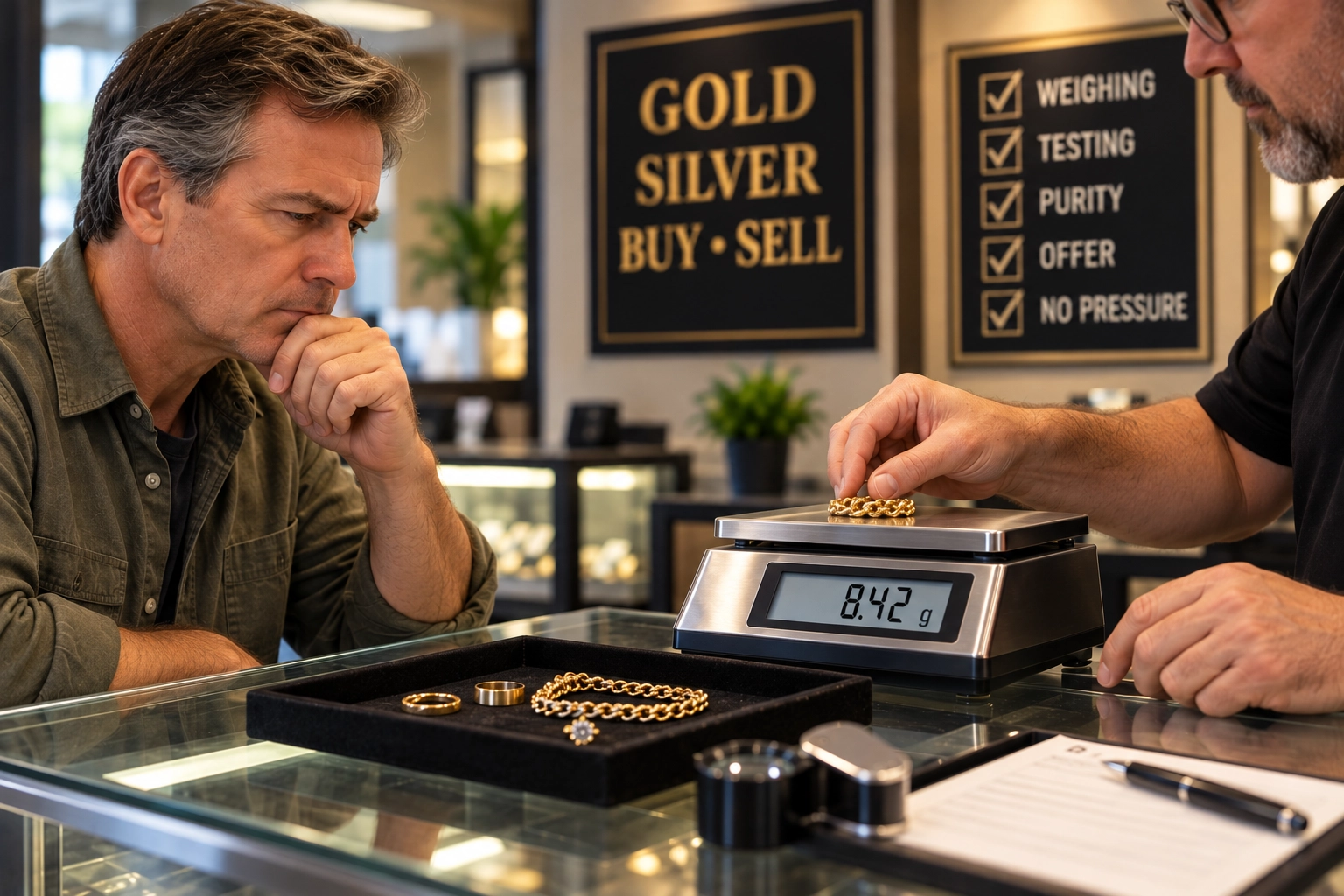
The red flag: You cannot see the weighing process, the item disappears into a back room without explanation, or the buyer will not tell you the weight and unit being used.
What to do instead: Don’t let your gold leave your line of sight. Understand both the weight number and the measurement unit. Common precious-metal weight units include:
- g = grams
- dwt = pennyweights (1 dwt is about 1.55517 grams)
- ozt = troy ounces (1 ozt is about 31.1035 grams)
- gr or gn = grains (1 grain is about 0.064799 grams)
The unit itself is not a red flag. Grams, pennyweights, troy ounces, and grains are all legitimate units. The important thing is knowing which unit is being used so you can compare the buyer’s numbers with your own.
3. Destructive Testing Is Done Without Your Permission
Gold, believe it or not, can be counterfeited, and buyers are understandably very cautious to avoid buying fake gold. Several methods are used to determine if gold is real or fake. Some testing methods can scratch, file, or otherwise alter an item, while others use non-destructive testing instruments. Touchstone and acid testing have been used for a long time and are still used today. In contrast, there are non-destructive methods, including X-ray fluorescence (XRF) analyzers, electronic gold testers, and ultrasonic testers. The important point for a seller is to understand which type of test will be used before testing begins.
The red flag: A buyer files, cuts, scratches, or applies acid directly to your jewelry without your permission.
Why this hurts you: Deep notches permanently damage jewelry. If you decide not to accept their cash offer, you leave the shop with a ruined piece that can no longer be worn or resold as fine jewelry.
What to do instead: Understand how the item will be tested before the testing takes place. Insist they do not perform destructive tests without your explicit permission.
Related: How Can I Tell If My Gold Is Real?
4. The Offer Is Far Below the Gold’s Melt Value and You Cannot Explain the Difference
Precious metals are commodities with live spot prices quoted internationally per troy ounce (31.1035 grams). Scrap buyers typically pay below melt value to account for overhead, refining costs, risk, and profit. The useful question is: How does the offer compare with the melt value of the gold?
The red flag: The offer is far below the calculated melt value and the buyer cannot clearly explain how the offer was determined.
NOTE: If you are selling gold coins with a face value stamped onto the coins themselves, understand that face value is not melt value, and melt value does not factor in possible collectible value.
What to do instead: Know the melt value before you hear the offer. Use the PreciousCalc Gold Calculator to enter the weight and karat to estimate the value of the gold itself. Then compare the transaction price (the offer) with melt value. The difference is information you can use when deciding whether the offer makes sense.
5. An Item with Possible Value Beyond the Gold Is Treated Only as Scrap
Melt value measures the value of the precious metal contained in an item. It does not measure everything else that might make the item valuable.
Designer jewelry, collectible coins, antique pieces, historically interesting objects, craftsmanship, and gemstones can all create value beyond the metal itself.
The red flag: An item that may have meaningful resale, collectible, designer, or gemstone value is immediately valued only for its gold content without any discussion of those other possibilities.
What to do instead: Consider whether the item belongs in a different market before selling it as scrap. A qualified appraiser, estate jeweler, coin specialist, auction house, consignment shop, or secondary luxury market may be more appropriate depending on what you have.
If a scrap buyer is interested only in the gold and not the gemstones, ask whether the stones can be removed and returned to you.
Related: What Is It Really Worth? When Melt Value Is Only Part of the Story
6. High-Pressure Tactics or an Offer You Cannot Review
Spot prices move during the day, so a buyer cannot necessarily hold the exact same offer indefinitely. That is different from using pressure to keep you from understanding the transaction.
The red flag: You are told the offer is good “right now only,” discouraged from asking questions, or given a total with no explanation of the weight, purity, or pricing behind it.
What to do instead: Ask for the numbers used to calculate the offer. Depending on the transaction and local requirements, the paperwork you receive may vary, but you should be able to understand what you are being offered and why. If you are not comfortable, walk away.
Before You Sell
- Sort first. Group items by karat markings when possible.
- Weigh at home. Get a reasonable idea of the weight before you leave. A jewelry scale is better suited to small items than many kitchen scales.
- Know the melt value. Use the item’s weight, purity, and current spot price to establish a benchmark.
- Compare the actual offer. Do not let different quoting units distract you. What matters is the total amount you will receive and how it compares with the value of the gold.
You Can't Make a Good Deal With a Bad Person
Know your numbers, but also pay attention to the person across the counter.
A scale can tell you the weight. A hallmark can give you information about purity. A calculator can tell you the melt value. None of those things can tell you whether the person you are dealing with is trustworthy.
Ask questions. Protect how your items are handled. Understand how the offer was calculated. Trust your instincts. And if something does not feel right, you do not have to make the deal.
References
- NIST Handbook 44, current 2026 edition — commercial weighing and measuring device requirements
- NIST Weighing and Scales FAQs — commercial scale inspection and approval
- NIST Guide to the SI / Handbook 44 Appendix C — troy ounce, pennyweight, and grain conversions
- FTC Consumer Advice — gold karat content
- GIA — touchstone testing for karat gold
- GIA — XRF and limitations involving plated gold
* NIST Handbook 44 provides widely adopted technical requirements for commercial scales, and NIST says a scale used commercially must be inspected and approved by the authorized body in the state where it is used. Exact requirements can vary by jurisdiction and by the type of scale.
This article is provided for informational and educational purposes only and does not constitute financial, investment, appraisal, legal, or other professional advice. Actual offers may vary based on testing results, market conditions, buyer costs and margins, and other factors. An item's collectible, antique, gemstone, artistic, historical, or resale value may be significantly different from its precious-metal melt value.